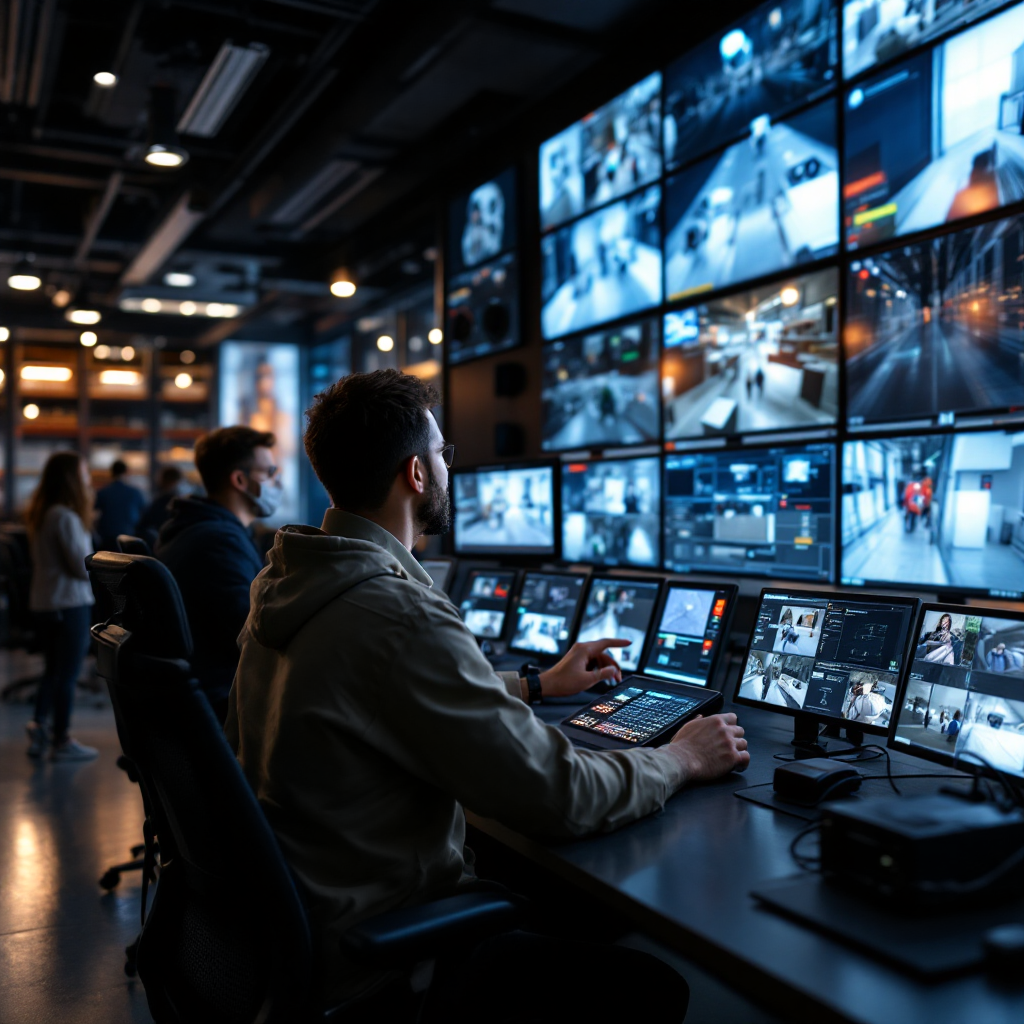
AI and computer vision: Unlock video understanding in CCTV
AI has matured enough to change how we process hours of footage. AI and computer vision now run together to provide fast, reliable video understanding. They filter video inputs and then classify people, vehicles, and objects so teams can act. For enterprises that sit on terabytes of archived video content, this shift helps operators search and act on specific events. Visionplatform.ai builds on this approach so your existing VMS streams become operational sensors. For an example of targeted detection on live streams see our people detection page for airports: people detection in airports.
Practical systems combine trained models with simple rules. A vision-language model can add captions and metadata so teams handle incidents more quickly. Benchmarks show state-of-the-art VLMs deliver accuracy improvements of roughly 15–20% over vision-only systems, which improves both precision and recall in action recognition 15–20% accuracy improvement. In noisy or occluded scenes, robustness tests show VLMS maintain more than 90% accuracy, and they outperform baselines by about 10% under challenging conditions robustness >90%. These gains speed up triage and reduce false alarms, and they cut time to investigate.
Video analytics tools must also respect deployment constraints. On-prem processing helps with compliance, and GPU-equipped servers or edge devices enable high-resolution streams to be analysed without moving data offsite. Fine-tuning methods have reduced compute for VLMs by roughly 30%, which helps with cost and latency in real-time deployments 30% compute reduction. Operators get fewer false alerts and more accurate tags. This approach supports smart surveillance in smart cities, and it integrates with existing VMS and security stacks so teams gain actionable intelligence and a practical path to operationalise video data.
Vision-language model fundamentals: Natural language and surveillance
A vision-language model blends visual inputs with plain language so systems can answer questions about a scene. These models combine a vision encoder with a language model and then apply cross-modal attention to connect pixels to words. The result supports VQA, captioning, and scene understanding. Security operators can type a question like “Who entered the restricted area at 15:00?” and get a grounded, time-stamped answer. This ability to answer queries using natural language unlocks fast forensic workflows and video search workflows. For advanced examples of searching footage see our forensic search page: forensic search in airports.
Architecturally, advanced systems use transformer stacks that transform image tokens and text tokens in a shared context window. A vision encoder extracts features from frames, and cross-attention layers let the language side attend to those features. This multimodal fusion supports many vision-language tasks and it makes scene understanding more contextual. Researchers note that “the fusion of visual and linguistic modalities in large vision-language models marks a paradigm shift in CCTV analytics” Dr. Li Zhang quote. That quotation highlights the core capability: systems not only see, but they provide a detailed response grounded on the visual evidence.
VQA and captioning are practical. Operators ask, and the system returns a VQA answer or a time-coded caption. The models help classify suspicious behavior, detect loitering, and enable automated video search. In one setup, a VLm tags frames with semantic labels, and then a language model generates a short incident report in plain language. This dual capability reduces manual review, and it improves throughput for both security teams and operations.
AI vision within minutes?
With our no-code platform you can just focus on your data, we’ll do the rest
Build and deploy a real-time pipeline for vision language model
Design a pipeline in stages: data ingestion, pre-processing, model inference, and alerting. Ingest streams from cctv cameras and then normalise frame rates and resolution. Next, apply a vision encoder to extract features and pass them to the vision-language model for multimodal reasoning. After inference, publish structured events to downstream systems so operations and security can act. This pipeline approach helps you optimise latency and throughput. For vehicle and plate scenarios consider integrating ANPR modules and see our ANPR/LPR work: ANPR/LPR in airports.
Keep compute tight. Use frame sampling, early exit models, and quantisation to reduce GPU costs. Research shows resource-efficient fine-tuning cuts compute by about 30% while keeping performance high resource-efficient fine-tuning. Also, choose batching and asynchronous inference so real-time decision-making scales. Deploy either on a local GPU server for many streams or on edge devices for distributed sites. Our platform supports both edge devices and on-prem deployment so you own your dataset and event logs.
For deployment, manage models and data with clear safety protocols. Keep training data private and auditable, and use small validation datasets to monitor drift. Monitor model health and set thresholds for alerts. When an alert triggers, include timecode, thumbnail, and metadata so investigators get full context quickly. This reduces false positives and speeds incident resolution while maintaining compliance with EU AI Act expectations and operational policies. Finally, ensure the pipeline supports scale from a handful of cameras to thousands, and that it integrates with VMS and MQTT streams for downstream analytics and dashboards.
Agentic AI system: Integrating LLM and VLM for smart CCTV
An agentic AI system pairs a VLM with a large language model and then gives the combo action capabilities. The VLM supplies visual facts. The LLM handles reasoning and command planning. Together they create an AI agent that can summarise scenes, route tasks, and escalate incidents. This fusion supports automated patrol routing and dynamic camera prioritisation. For intrusion detection scenarios, tie these decisions to access control and alarm panels so operators get context-rich alerts. Integrating LLM and VLM enables an ai system that reasons and acts on video data.
Start with a decision loop. First, the VLM processes video inputs and flags specific events. Next, the llm composes a plan for follow-up. Then, the agent executes actions like opening a camera preset, sending an alert, or generating a report. This loop supports real-time video analytics and real-time video for tactical response. The agent uses the context window to maintain short-term memory and continuity across frames. It can also provide a detailed response or a compact summary for busy operators. In practice this approach reduces time to investigate and increases the quality of actionable intelligence.
Technically, integrate with existing vision systems and security systems through well-defined APIs. Use policy layers that verify actions before they execute. Keep sensitive steps on-prem to comply with safety protocols and legal rules. Generative AI can draft incident narratives, and the agent can attach evidential thumbnails and a timestamped log. This mix of automation and oversight makes intelligent security systems both efficient and accountable. In R&D, teams test the agent on synthetic and live data so the AI agent learns to prioritise specific events and to classify behaviour accurately.

AI vision within minutes?
With our no-code platform you can just focus on your data, we’ll do the rest
Optimise CCTV analytics workflow and use cases with AI agent
Streamline operator tasks so they spend less time watching and more time resolving. An AI agent can tag events, generate short summaries, and push those summaries into dashboards so teams see priority incidents first. This workflow reduces review load and helps classify incidents like restricted area breaches and slip, trip or fall events. For example, our platform supports perimeter and loitering detection integrations so teams get relevant feeds and context fast: loitering detection in airports. Use case examples include action recognition, anomaly detection, automated captioning, and ticket creation for follow-up.
Action recognition models can detect gestures and motions, and then the AI agent filters low-risk events. Anomaly detection highlights rare patterns and then sends an alert to an operator with suggested next steps. Automated captioning turns hours of footage into searchable logs and then enables rapid video search for forensic work. These capabilities provide actionable intelligence for security staff and operations teams so both security and operational KPIs improve. They also help optimise resource allocation and traffic management at busy sites.
To reduce false alarms, tune models on local datasets. Use feedback loops from operators to retrain models and to improve classification. Provide confidence scores and allow operators to confirm or reject automated tags. This closed loop raises accuracy and decreases alarm fatigue. Finally, connect events to business systems via MQTT or webhooks so cameras become sensors for OEE, building management, and BI. That step helps go beyond traditional alarm systems and turns video into measurable operational value.
AI developer guide: Unlock language model potential in surveillance
Developers should fine-tune language model components for domain specificity and then test them on representative datasets. Start with small, labelled clips and then expand. Use transfer learning on the vision encoder so models learn site-specific visual cues. Track metrics and log errors so you can iterate. Tools like containerised model serving and experiment tracking make this process repeatable. For certified deployments, include safety protocols and maintain auditable logs. For tips on deployments with edge hardware see our thermal and PPE pages which outline practical deployment strategies for airports: PPE detection in airports.
Pick frameworks that support both training and inference on GPUs and on edge hardware. Use mixed precision, pruning, and distillation to reduce model size and latency so you can run on smaller gpus or on Jetson-class edge devices. Monitor drift and use human-in-the-loop workflows to keep models accurate. Consider privacy-preserving techniques such as federated updates and local fine-tuning to keep datasets private. Plan for lifecycle management so models are versioned and certifiable for safety and compliance.
Look ahead. Research will continue to make VLMS more efficient, and both model architectures and tooling will advance. Future work will emphasise privacy-preserving VLMs, adaptive learning loops, and stronger integration between vision-language components. For teams building smart vision offerings, focus on iterating quickly and on measuring real operational impact. That approach turns proofs of concept into production systems that deliver intelligent security and measurable ROI.
FAQ
What is a vision-language model and how does it help CCTV?
A vision-language model links visual features to textual reasoning. It helps CCTV by producing captions, answering queries, and flagging events with context so investigators can act faster.
How accurate are VLMs compared to vision-only models?
Recent benchmarks report accuracy gains in action recognition of roughly 15–20% for VLMs versus vision-only baselines. Robustness testing has also shown that VLMS can maintain high accuracy under occlusion and noise.
Can VLMs run on edge devices or do they need servers?
Yes, VLMs can run on both edge devices and GPU servers with the right optimisations. Techniques like quantisation and pruning help them fit on constrained hardware and speed up inference.
How do I integrate VLM outputs with my VMS?
Most VLM deployments publish structured events via MQTT or webhooks to downstream systems. This lets you send alerts and metadata directly into your VMS or security dashboards for immediate action.
Are there privacy or compliance concerns with on-prem deployments?
On-prem deployment reduces data exfiltration and helps satisfy regional regulations such as the EU AI Act. Keeping datasets and logs local also simplifies auditing and compliance.
What are common use cases for vision-language models in security?
Common use cases include action recognition, anomaly detection, automated captioning, and rapid video search. These capabilities speed investigations and reduce manual review time.
How do I reduce false alarms in an AI-powered CCTV system?
Use local fine-tuning on your dataset, add human-in-the-loop verification, and expose confidence scores to operators. Continual retraining with corrected labels also improves long-term precision.
What hardware do I need to run real-time VLM inference?
For many streams, a GPU server provides the best throughput, while modern edge devices can handle single or low-count streams. Choose based on camera count, resolution, and latency requirements.
Can VLMs answer natural language questions about footage?
Yes, VLMs with VQA capabilities can answer questions such as who entered a restricted area at a specific time. They ground answers in visual evidence and attach timestamps for verification.
How should an AI developer start building VLM-enabled CCTV features?
Begin with a clear dataset and a minimal viable pipeline: ingest, pre-process, infer, and alert. Then iterate with monitored deployments, operator feedback, and efficient fine-tuning to scale safely.