understanding ai: how every ai agent drives modern security operations
Understanding AI starts with the AI agent concept. First, an AI agent is a software entity that senses inputs, reasons about them, and acts to achieve goals. Second, agentic AI extends that idea with autonomous decision paths and multi-step plans. In practice, every AI agent will combine machine learning, policy rules, and connectors to security data. This lets the agent detect suspicious flows and recommend or execute actions without human delay. For those building systems, integrating an AI agent means mapping inputs, outputs, and safety gates.
AI agent capabilities include pattern recognition, contextual correlation, and automated playbooks. Also, an AI agent can call an ai model to inspect files or logs. In SOC settings, the agent reduces repetitive tasks so teams can work on complex incidents. This approach helps reduce alert fatigue and frees analysts to focus on deep investigation. For example, Visionplatform.ai turns CCTV into operational sensors and streams structured events so AI agents have richer context, and analysts get fewer false alarms (people detection).
As modern security operations evolved, teams moved from manual ticket triage to data-driven orchestration. Initially, SOCs relied on static rules. Then, detection improved with signature and behavioral analytics. Now, AI agents operate across the security stack and apply threat intelligence to prioritize findings. This transforms how a security team responds. A PwC-style adoption figure shows wide use: about 79% of businesses already use agents in their security operations, and many quantify gains in response times and detection accuracy (AI Agents Statistics 2025).
AI agent design must balance speed with control. Every agent should have permission boundaries and audit logs. Agents integrate with existing tools such as a security information and event management system to avoid breaking workflows. Agents are granted broad permissions only when oversight and auditing exist. This prevents privilege escalation and limits lateral movement risks. As teams implement AI, they should promote transparency so human analysts retain final authority. Understanding AI means planning for continuous validation and for human-in-the-loop review to keep modern security operations effective.
soc and autonomous soc: building an ai solution for real-time alert triage
The SOC landscape now includes hybrid human–machine centers. Traditional SOCs used analysts to watch dashboards and to follow escalation paths. Today, the shift toward an autonomous SOC blends automation and adjudication. An AI agent can classify an alert, enrich it with threat intelligence, and then prioritize it for remediation. This reduces mean time to respond and improves SOC efficiency. For CCTV-driven signals, our platform streams contextual video events to make triage faster (forensic search).
Building an AI solution for real-time triage requires several components. First, collect telemetry from endpoints, network sensors, and cameras. Second, normalize and enrich data. Third, run an AI agent that scores, labels, and routes findings. Fourth, connect to playbooks for automated or semi-automated response. Teams should include a human review gate for high-risk changes. Use AI agents to automate low-risk remediations while routing uncertain cases to analysts. This design improves response times and preserves safety.
Metrics show gains when triage is automated. Organizations report lower MTTR and higher alert fidelity after adopting automated triage. One industry source predicts broad market growth in autonomous agent deployment by 2026, reflecting those benefits (AI Agent trends 2025). In practice, SOC analysts see fewer noisy alerts and more actionable incidents. As a result, human analysts spend time on complex investigation and root cause analysis instead of on repetitive tasks. For video-based anomalies, integrations with vehicle detection and intrusion feeds help prioritize threats across physical and cyber domains (intrusion detection).

To succeed, implement continuous validation of AI outputs. Track false positive and false negative rates. Run regular audits of agent actions and adjust thresholds. Apply role-based permission to ensure agents don’t change critical network settings without approval. With this approach, an AI solution delivers real-time classification and helps teams prioritize threats while keeping oversight intact.
AI vision within minutes?
With our no-code platform you can just focus on your data, we’ll do the rest
use cases for ai agents: using ai agents in security workflows and playbooks
Use cases for AI agents are broad. They range from malware analysis to insider-threat detection and from phishing triage to physical security fusion. For example, an AI agent can ingest email headers, extract indicators of compromise, and trigger a containment playbook. Similarly, a vision-driven AI agent can flag a vehicle of interest using ANPR/LPR feeds and then notify the security team for ground follow-up (ANPR/LPR in airports).
AI agents automate routine forensic steps. They snapshot endpoints, collect logs, and run signature checks. They also enrich data with threat intelligence. In malware cases, an AI agent can run behavioral sandboxing and return a verdict for the playbooks to act on. This shortens investigation loops. The approach uses an ai model for deep inspection and then hands complex signals to human analysts for validation.
Embedding AI agents into security workflows requires careful design. First, map decision points where the agent can add value without replacing human judgment. Next, codify playbooks and ensure they are auditable. Then, add rollback controls so playbooks can reverse actions if they cause side effects. Best practices call for staged deployment: start with read-only tasks, then expand to automated remediation for low-risk events. Also, ensure that all agent actions are logged for audit and compliance.
Human–AI collaboration is crucial. An AI agent should suggest courses of action. Human analysts should approve or refine those suggestions. This model keeps humans in the loop for sensitive decisions. It also reduces analyst burnout and alert fatigue, and it helps the security team to handle more incidents with the same staff. Use AI agents to orchestrate tools that can’t cover cross-domain contexts alone. For example, linking camera detections with network indicators creates richer incident context and accelerates accurate outcomes.
agentic ai and gen ai: ai agents at scale for the security team
Agentic AI differs from generative AI in purpose and orchestration. Generative AI excels at synthesizing reports or at expanding analyst notes. Agentic AI focuses on autonomous agents that sequence actions across systems. In the SOC, gen AI can write a summary. Meanwhile, agentic AI runs the triage steps and coordinates external queries. Both have roles. Use gen AI for narrative tasks and agentic AI for goal-driven automation.
Deploying AI agents at scale requires orchestration and resource governance. Start with a control plane that manages agent versions, permissions, and compute budgets. Next, use telemetry to route tasks to agents that match the domain knowledge. Resource management prevents runaway processes and limits costs. This approach ensures agents work efficiently and remain accountable.
Scale affects the security team in measurable ways. Staff productivity improves. Teams that integrate large-scale agents report fewer repetitive tickets and faster incident response. Some surveys show daily AI-powered threats are expected, so automated defenses help defend at machine speed (AI-powered attacks report). However, scaling also requires reskilling. Security personnel need training in agent oversight and in writing secure playbooks. For vital tasks, hire or train an AI SOC analyst to tune agents and to perform audits.
When agents operate at scale, governance matters. Define policy for agent actions, require an audit trail, and mandate human review for high-impact steps. Agents act faster than humans and can be fully autonomous for low-risk tasks, but teams must guard against mistaken remediation. To mitigate this, implement phased autonomy and continuous testing. This preserves the organization’s resilience while enabling AI-driven scale.
AI vision within minutes?
With our no-code platform you can just focus on your data, we’ll do the rest
ai agent security: secure your ai and prioritise governance
Securing AI requires focused governance. AI agent security starts by identifying principal risks. These include goal hijacking, malicious C2, and data exposure. Agents that can make changes must have strict permission limits. Also, agents are granted broad permissions only with auditable justification. Without those controls, privilege escalation and lateral movement become real hazards.
Adopt a governance framework that includes risk assessment, continuous monitoring, and audit trails. McKinsey recommends governance to “address autonomous system risks and ensure secure collaboration among AI agents” (McKinsey). Include periodic security posture reviews and red team exercises. Also, monitor for malicious inputs and adversarial attempts to manipulate models. For web-exposed agents, validate all external commands and use allow-lists.
Apply technical controls. Use encryption for sensitive data and limit retention. Segment networks so agents cannot access unrelated critical systems. Log every agent action so audits are straightforward and reproducible. Implement a safety net where human analysts can override agent actions and can roll back changes. An AI agent security plan should specify the conditions under which agents can autonomously remediate and when they must ask for permission.
Operational practices matter too. Provide training that helps the security team to spot anomalous agent behavior. Use continuous validation to detect model drift and to confirm detection accuracy. For CCTV integrations, keep model training local to preserve privacy and compliance; Visionplatform.ai supports on-prem model control to protect sensitive data and to align with the EU AI Act. Finally, document incident response plans that cover agent compromise, and run regular audit cycles. These steps close gaps between speed and safety, and they keep AI adoption sustainable.
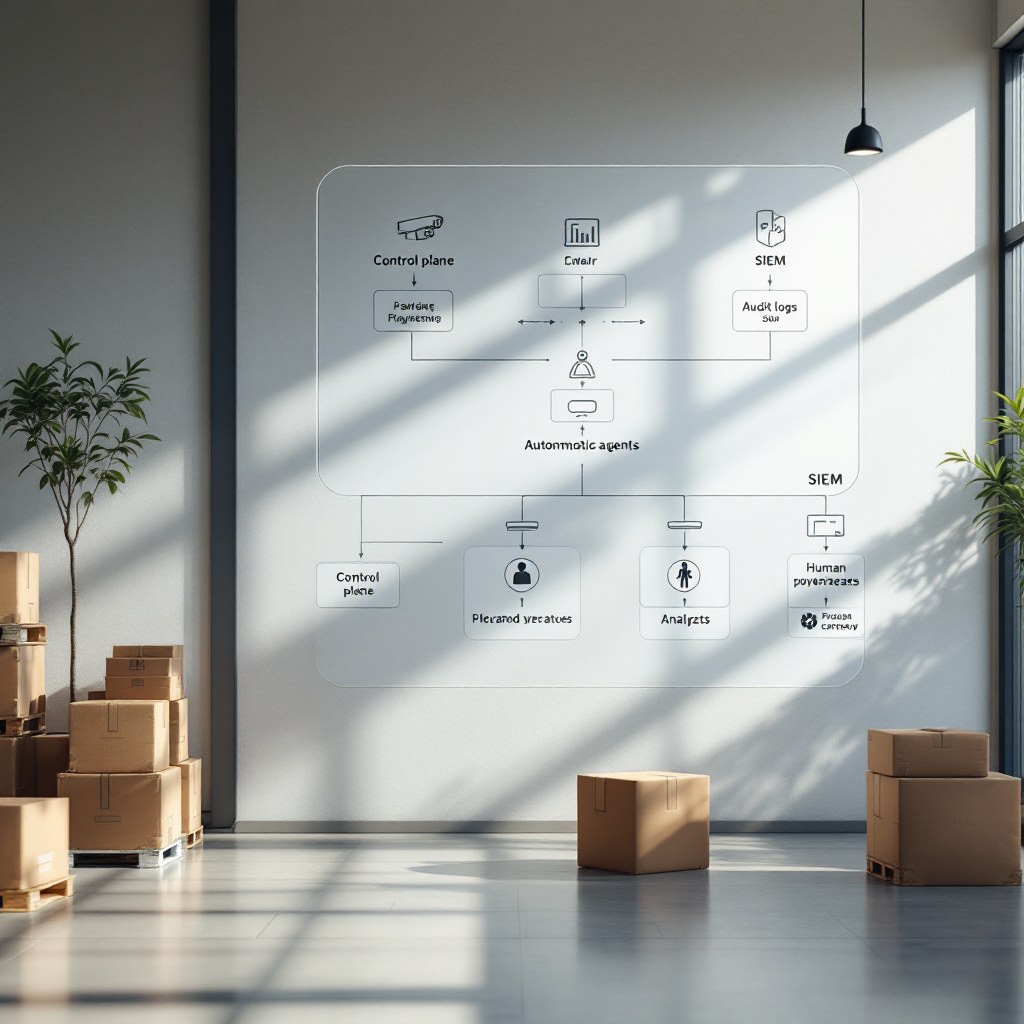
real-time alert response: prompt-led autonomous workflow optimisation
Prompt design matters for precise responses. A well-formed prompt guides the AI agent toward safe, auditable action. Begin with short, unambiguous instructions. Then, add constraints and expected outputs. Use templates for common incident types. This reduces mistaken actions and cuts back-and-forth between machine and analyst. Keep one documented prompt library and require review for changes.
Autonomous workflows can auto-remediate incidents when risk is low. For example, an agent may isolate a compromised host, contain a suspicious process, and then notify the security operations center. To do this safely, the workflow should include verification steps, a rollback path, and a human approval gate for high-impact remedies. For vision-led incidents, like unauthorized access detection, automated workflows can correlate camera events with access logs and trigger guard notifications (unauthorized access detection).
Continuous feedback loops improve both prompts and playbooks. Log outcomes and analyst decisions. Then, retrain the ai model and tune rule thresholds. Regularly measure MTTR and false positive rates. These metrics show whether the system improves over time. Also, prioritize incident cases that reveal gaps and adjust the prompt templates accordingly. This cycle makes the system resilient and adaptive.
Operational safeguards reduce risk when agents act autonomously. Use canary deployments for new workflows. Run staged experiments and monitor for regression. Require that agent actions are reversible and that audit trails capture root cause. When done well, prompt-led workflows speed remediation and reduce time wasted on repetitive alerts. The end result is a continuous security posture that scales with threats while keeping human analysts in the loop.
FAQ
What is an AI agent in SOC contexts?
An AI agent is a software entity that observes inputs, reasons, and acts to achieve security goals. It may run steps autonomously or propose actions for human analysts to approve.
How do AI agents reduce alert fatigue?
AI agents filter and enrich raw alerts, which cuts the volume of noisy items. As a result, human analysts see higher-quality incidents and can focus on deep investigations.
Can AI agents fully replace SOC analysts?
No. Agents automate repetitive tasks and low-risk remediations, but complex investigations still need human judgment. Agents provide suggestions while analysts validate sensitive decisions.
What are common use cases for AI agents?
Use cases include malware analysis, insider-threat detection, phishing triage, and physical security fusion with camera feeds. Vision integrations extend detection to vehicles and loitering events.
How do you secure AI agent deployments?
Secure deployments require role-based permissions, segregation of duties, audit logs, and continuous validation. Also, restrict data access and run red-team exercises to test agent resilience.
What is the difference between agentic AI and gen AI?
Agentic AI focuses on autonomous agents that sequence actions across systems. Gen AI focuses on content generation and summarization tasks. Both can complement SOC workflows.
How do prompts affect autonomous workflows?
Prompts define the agent’s intended behavior and constraints. Clear, tested prompts reduce erroneous actions and make automated remediation safer and more predictable.
What metrics should I track after deploying agents?
Track MTTR, false positive and negative rates, and the proportion of incidents handled autonomously. Also, measure analyst time saved and the number of escalations to human teams.
Are AI agents compliant with privacy rules like the EU AI Act?
Compliance depends on deployment. On-prem and edge processing with local model control helps meet EU regulatory needs. Keep data and training local when required.
How can small SOC teams start with AI agents?
Start small by automating read-only tasks and by integrating agents with existing SIEM and camera feeds. Expand autonomy gradually and provide training so the security team can monitor and tune agent behavior.