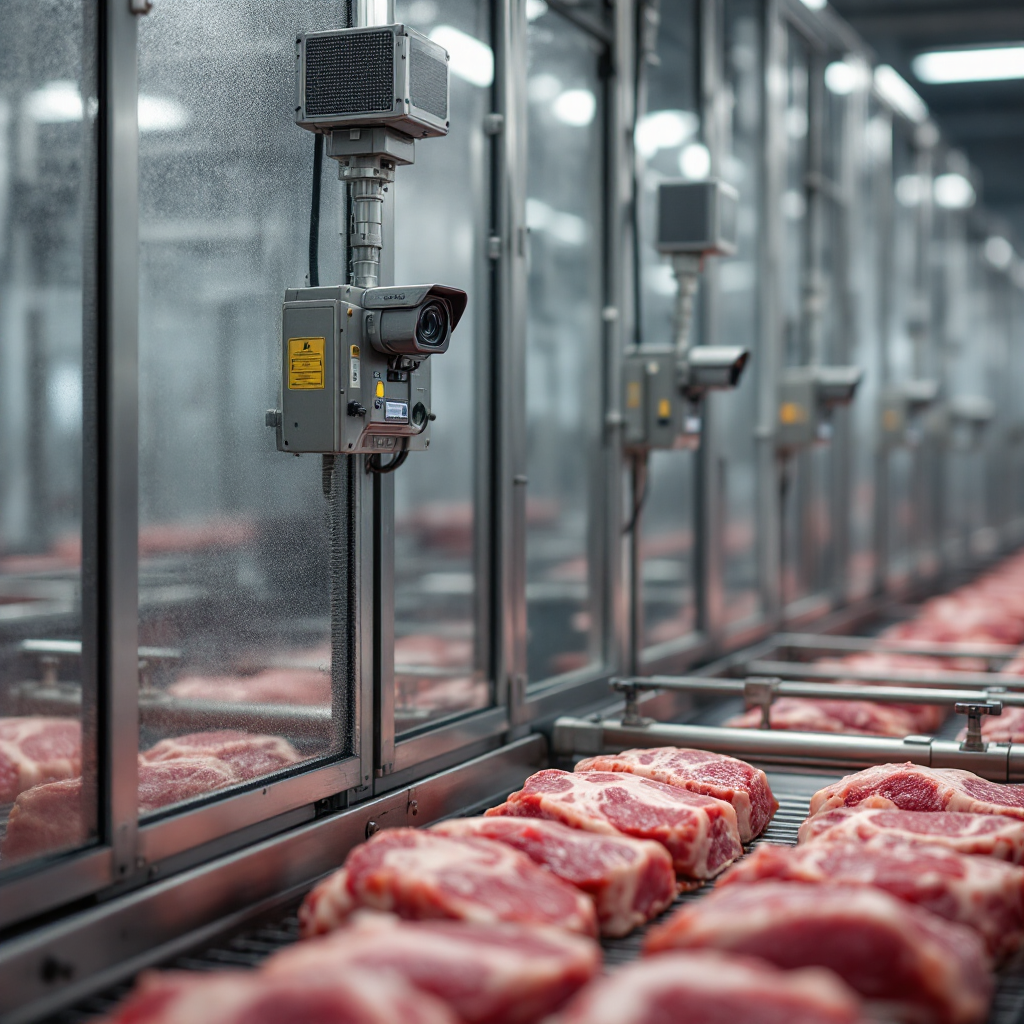
artificial intelligence in carcass inspection: an overview
AI has reshaped how processors inspect carcasses. First, it replaced slow, subjective visual checks with fast, repeatable analysis. Next, systems moved from rule-based filters to computer vision driven by learning algorithms. For example, recent reviews highlight camera surveillance upgrades that strengthen food safety and inspection service in slaughterhouses (IFT review). Also, AI now supports quality control by cross-checking visual cues against historical outcomes. In addition, teams use machine learning to train models on annotated images. Then, those models classify and flag anomalies in real time.
The core principles rest on image analysis and pattern recognition. Specifically, convolutional neural networks and other neural architectures parse pixels into candidate features. Also, feature maps extract texture, colour, and shape. Therefore, these systems improve detection of soiling, lesions, and blood pooling. Moreover, combining camera feeds with sensor telemetry gives richer context. However, the phrase artificial intelligence must be paired with practical integration. For instance, Visionplatform.ai helps processors reuse VMS footage to refine models on-site, and that keeps data local and auditable. This approach reduces vendor lock-in and supports GDPR and EU AI Act readiness. In addition, our platform streams events for operational use, which helps plant managers react faster. Next, AI reduces human error by offering consistent thresholds and audit trails. Finally, when regulators audit performance, recorded detections supply verifiable evidence that supports compliance.
Historically, adoption moved in steps. First came static image scoring. Then came real-time inference at line speed. Now, teams deploy edge devices for low-latency decisions. Also, some processors combine AI with spectroscopic sensors to detect hidden contaminants, and studies report sensitivity gains versus human inspection (ResearchGate). Overall, this evolution shows clear benefits for MEAT PROCESSING, food safety, and operational KPIs. Furthermore, processors that adopt AI can improve throughput while protecting consumers and brands.
machine vision for contamination detection on carcass surfaces
High-resolution cameras and imaging systems now power contamination detection. First, VIDEO and still frames capture surface texture and colour. Then, deep learning and fluorescence imaging help to separate organic residues from muscle. For example, teams use multispectral imaging and hyperspectral images to expose differences invisible to the human eye. Also, systems using deep learning models and convolutional neural network layers have demonstrated high accuracy at spotting soiling and fecal marks. Specifically, one study reports object detection and classification accuracies exceeding 90% on pig carcass contamination (MDPI study). Therefore, processors can automatically identify fecal contamination and remove affected items before packaging.
Also, multispectral fluorescence imaging systems pair well with convolutional neural networks. In addition, combining deep learning and fluorescence isolates biological residues from normal tissue. For example, fluorescence imaging to automatically identify contamination can flag visible fecal contamination that visual inspection might miss. Next, imaging and machine learning workflows feed annotated datasets into classification models. Also, teams label video frames with fecal and non-fecal examples to train segmentation and classification layers. Then, training uses augmentation and cross-validation to improve generalisation. Furthermore, line-scan hyperspectral imaging performs well at high speeds. Consequently, processors can inspect carcasses at production line rates without losing sensitivity.
To integrate this tech, companies apply machine learning algorithms that balance sensitivity and specificity. Also, they monitor false alarms and tune thresholds. In practice, food processors aim to detect fecal contamination on meat carcasses while keeping throughput steady. Additionally, an imaging technique that fuses visible and NIR bands often yields the best results. Finally, platforms like Visionplatform.ai make it possible to run these models on existing CCTV, which helps sites reuse footage and keep training data private. For more on video-driven detection and operational analytics, see our process anomaly approaches process anomaly detection.
AI vision within minutes?
With our no-code platform you can just focus on your data, we’ll do the rest
artificial intelligence for bleeding defect identification on carcass
Detecting bleeding defects requires specialised imaging and targeted models. First, under-bleeding and residual blood pools show subtle contrast differences. Next, teams collect images under controlled lighting to boost signal-to-noise. Also, hyperspectral and multispectral imaging can reveal hemoglobin signatures that standard RGB cameras miss. For example, integrating spectroscopic data with deep learning improves sensitivity and specificity by roughly 15–20% compared to conventional methods (ResearchGate stat). Therefore, processors can confidently flag carcasses that failed bleeding protocols.
Building training datasets takes time. First, experts annotate pools, streaks, and under-bleed regions. Then, annotation teams include meat inspectors and pathologists to ensure labels are accurate. Also, data must reflect seasonal and breed variations. In addition, datasets should include sheep carcasses, chicken carcasses, and pigs to support cross-species models. Next, teams train convolutional neural networks and tune hyperparameters. Also, they often combine supervised classification with segmentation to both locate and classify defects. For example, a classification model labels a region as ‘residual blood’ while a segmentation mask maps its shape.
Combining spectroscopic readings with image analysis works well. Specifically, feeding hyperspectral images into neural pipelines helps the model distinguish blood from bruising and dark muscle. Also, deep learning algorithms can fuse modalities and learn joint representations. Next, processors deploy optimized inference stacks at the edge to keep latency low. In practice, that means each carcass is scanned and scored within a second or two, so throughput remains high. Additionally, good systems create traceability records. For example, Visionplatform.ai streams structured events to MQTT, which helps link a flagged carcass to timecode and camera ID. Finally, this traceability helps during audits and when corrective actions are required.
inspection integration in food safety systems
Real-time AI monitoring transforms the production line. First, cameras capture each carcass as it moves. Then, the imaging system runs inference and issues pass/fail events. Also, events feed into the plant SCADA or MES for automated handling. For example, an inspection system can trigger an actuator that diverts a flagged carcass to a reject lane. Next, the system writes an auditable log so teams can trace the issue later. In addition, operators receive a short clip and metadata to validate the decision. Therefore, AI reduces unnecessary rework and speeds corrective actions.

Traceability matters. Also, recording which camera, model, and threshold caused a rejection simplifies audits. Furthermore, food safety standards require records when a product is removed for potential contamination. For instance, processors aim to inspect carcasses and then link each rejection to a timestamped evidence clip for regulators. Also, integration with access control and PPE detection improves hygiene compliance. For related analytics in other high-throughput environments, see how people detection and PPE solutions apply to operational monitoring people detection and PPE detection. Next, secure on-prem processing preserves data privacy while keeping latency low. In addition, streaming events via MQTT converts cameras into sensors that feed KPIs and operational dashboards.
Finally, meeting regulatory standards requires documented performance. Also, systems should provide validation reports that show accuracy, sensitivity, and specificity. Therefore, regular revalidation is critical to account for model drift. In practice, many facilities schedule quarterly re-tests. Additionally, operator training helps ensure human review aligns with model outputs. As a result, AI becomes a dependable partner for inspectors and auditors.
AI vision within minutes?
With our no-code platform you can just focus on your data, we’ll do the rest
performance metrics for machine vision inspection of carcass defects
Key indicators measure how well a detection system performs. First, accuracy gives a broad view. Next, sensitivity and specificity reveal how many true defects the system finds and how many false alarms it creates. Also, processors monitor precision and recall to balance risk and throughput. For example, studies show AI models can reach high accuracy, often above 90% for certain contamination tasks (MDPI). Therefore, many plants set target thresholds before deployment.
Throughput rates matter too. For example, a processing plant may require each imaging and classification pass to finish within 500–2000 ms. Also, efficient pipelines use edge GPUs and optimized inference graphs. In addition, image size and processing techniques affect latency. For instance, downsizing frames reduces compute but may harm fine-grain detection. Next, teams use mixed resolutions, where a low-res pass triggers a high-res re-scan only when needed. Moreover, that design saves compute and keeps the line moving.
Benchmarking against human inspectors offers practical context. First, human error and fatigue affect consistency. Next, AI provides repeatable thresholds and auditable logs. Also, side-by-side trials often show AI reduces missed contaminants and supports faster throughput. For example, integrating spectroscopic signals with neural networks improved sensitivity roughly 15–20% over conventional inspection methods (ResearchGate). Additionally, inspectors still play a role in handling edge cases and verifying rejects. Therefore, the best systems treat AI as an assistant that scales human oversight rather than replacing it.
future of artificial intelligence in food safety and carcass inspection
The future combines sensor fusion and edge computing for robust systems. First, processors will blend RGB, multispectral imaging, and spectroscopic sensors. Then, advanced neural networks will fuse those modalities for richer representations. Also, this fusion will help detect contaminants and subtle bleeding defects. Additionally, hyperspectral imaging and machine learning offer promising paths for non-destructive evaluation. In fact, research on hyperspectral imaging and machine learning highlights improved contaminant discrimination in complex scenes (IFT review).
Scaling across species and plants brings challenges. First, models must adapt to different breeds, lighting, and equipment. Next, teams use transfer learning and incremental training to avoid full retraining. Also, Visionplatform.ai provides a flexible model strategy so teams can pick a library model, refine it on-site, or build anew using their VMS footage. Therefore, plants keep data local and maintain EU AI Act alignment. In addition, edge deployment reduces data movement and lowers privacy risk. Consequently, operators retain control while benefiting from continuous improvement.
Data governance and operator training matter too. First, data labels must stay consistent. Next, model drift requires ongoing validation and retraining. Also, clear audit logs and explainability features help during regulatory review. Finally, AI will integrate more tightly with MES and BI, so cameras become sensors that drive performance metrics and quality KPIs. For example, stream events into dashboards can help spot recurring contamination patterns and then inform corrective actions. As a result, the industry will not only detect defects but also prevent them, and that will help processors improve food safety. In short, with proper design and governance, AI will remain a practical tool to detect, classify, and reduce risks across the meat processing chain.
FAQ
What can AI detect on carcasses?
AI can detect visible contamination, bleeding defects, lesions, and soiling. Also, when combined with spectral sensors, AI can find residual blood and organic residues that the eye might miss.
How accurate are AI systems at spotting contamination?
Many AI systems report high accuracy, sometimes exceeding 90% for specific contamination tasks (MDPI). However, accuracy depends on data quality, lighting, and model tuning.
Can AI automatically identify fecal contamination?
Yes. Systems trained with labelled frames can automatically identify fecal contamination on meat surfaces and flag affected carcasses for removal. Also, fluorescence and multispectral methods improve detection of fecal contamination on carcasses.
Does AI replace human inspectors?
No. AI augments inspectors by automating routine detection and creating evidence logs. Also, humans still verify edge cases and handle removals that require judgement.
What imaging technologies work best?
Multispectral imaging, hyperspectral imaging, and fluorescence imaging often outperform RGB alone for subtle defects. In addition, line-scan hyperspectral imaging suits high-speed lines where per-carcass latency matters.
How do plants integrate AI with existing systems?
Plants link AI events into MES, SCADA, and dashboards to trigger automated diversion and to record traceability. For operational examples, see our process anomaly and people-detection integration pages process anomaly detection and people detection.
What is required to train effective models?
High-quality, annotated datasets that represent expected variability are essential. Also, teams need to include examples of fecal marks, blood pools, and normal tissue across breeds and seasons.
How do you handle false positives?
Operators tune thresholds and add verification steps. Also, combining spectroscopic signals with visual classification often reduces false alarms and improves specificity.
Is on-prem deployment important?
Yes. On-prem or edge deployment keeps data private, supports GDPR and the EU AI Act, and reduces latency. Visionplatform.ai specialises in on-prem model control and event streaming to operational systems.
Will AI improve food safety overall?
Yes. When properly designed, AI systems reduce missed contaminants and create traceable records that support audits. Also, these systems help teams prevent recurring issues, which helps improve food safety.