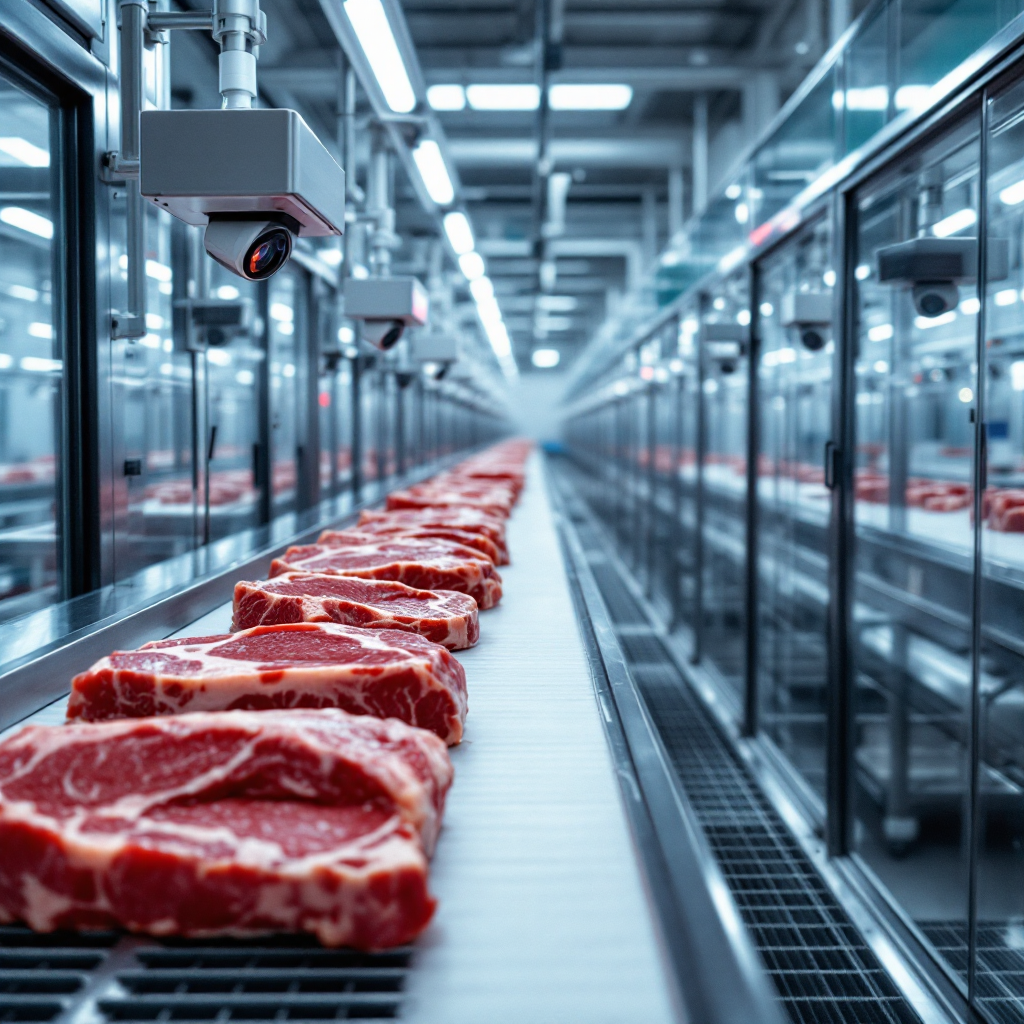
Artificial intelligence and computer vision in modern carcass grading
AI is changing how the meat industry measures value and consistency. Producers, packers, and retailers need fast, objective assessments to set prices and safeguard food quality and safety. AI and computer vision combine to read visual cues on a carcass, extract measurements, and output structured scores. These systems reduce human variability and improve traceability while keeping throughput high. For example, an improved YOLOv8x algorithm was built for beef marbling grading and showed measurable gains in speed and accuracy versus manual inspection Research on Beef Marbling Grading Algorithm Based on Improved YOLOv8x. This finding helps explain why firms prioritize AI for operational metrics.
AI supports regulatory compliance by creating auditable, repeatable inspections. Regulatory standards and industry benchmarks require documented decision rules. AI models can log detections, decisions, and confidence scores. This makes quality control easier to defend during audits. The use of a computer vision system that integrates with factory VMS also enables event streaming for dashboards and KPI monitoring, which turns cameras into operational sensors. Visionplatform.ai helps enterprises reuse existing CCTV footage and keep training local, which helps with GDPR and EU AI Act readiness. See how people-detection in airports shows camera-as-sensor use cases for operational analytics people-detection in airports.
Computer vision and AI systems deliver consistent grading and reduce inspection bottlenecks. They also provide data for longer-term trends in carcass composition and product quality. Machine vision tools detect marbling, external fat, and muscle contours with repeatable precision. A study that tested 602 beef steaks showed that computer vision reliably identified internal features for traceability and linked closely to expert scores Improving traceability and quality control in the red-meat industry. AI and artificial intelligence technologies together make scaling practical, and they enable new prediction model strategies across the supply chain.
Carcass characteristics and carcass composition
Carcass characteristics determine market value, and AI helps measure them fast. Key traits include marbling, fat-to-lean ratio, and muscle depth. Marbling drives tenderness scores and consumer preference, so graders focus on intramuscular fat. Fat-to-lean ratio influences yield and determines carcass weight and pricing. Carcass composition and value are central to negotiations between slaughterhouses and retailers.
Objective composition metrics feed both pricing models and safety controls. For example, carcass weight and muscle depth link to yield estimates and to the classification model used for product routing. The prediction of carcass value becomes more accurate when models use carcass images captured under controlled lighting. A prediction model can predict the quality of meat and help classify meat cuts for downstream processing. AI-based assessment also helps predict meat shelf life when linked to storage and temperature records.
Consumers expect consistent meat product quality. Retail brands measure product quality to reduce returns and complaints. Machine vision and spectroscopic tools can estimate intramuscular fat and colour, so processors can match expectations. Research shows that combining computer vision with conventional traits improves estimates of intramuscular fat Journal of Food Process Engineering. This linkage between objective measures and sensory results helps supply chains reduce waste and increase consumer trust. The review on meat quality evaluation notes that non-destructive approaches can scale while preserving samples A Review on Meat Quality Evaluation Methods Based on Non-Destructive ….
AI vision within minutes?
With our no-code platform you can just focus on your data, we’ll do the rest
Machine vision and computer vision system architectures
Machine vision system design shapes the accuracy of automated grading. Camera placement, lens choice, and lighting control determine the quality of images of the carcass. Imaging systems in high-throughput lines must keep exposure and colour calibration consistent. A dedicated imaging system uses fixed mounts and diffused lighting to avoid glare. Also, multi-angle cameras or hyperspectral sensors give extra spectral bands for deeper analysis.
Deep-learning frameworks process the images. Tools such as YOLOv8x and EfficientViT are now common in production. The YOLO approach excels at fast object detection, and EfficientViT offers a lightweight vision transformer option that reduces compute while preserving accuracy Beef Carcass Grading with EfficientViT. Combining convolutional neural networks with transformer elements often yields robust performance in noisy conditions. For some use cases, an artificial neural network trained on labelled carcass images can predict marbling scores and carcass classification with high agreement to experts.
Integration into slaughterhouse lines requires edge deployment and low-latency inference. Real-time event streaming and integration with VMS convert detections into operational data. Our platform approach supports on-prem edge processing so that enterprises retain training footage and model artifacts. This on-site strategy helps avoid vendor lock-in and supports EU AI Act compliance. For facilities that also need occupancy and counting analytics, camera outputs can feed people-counting tools for throughput and safety coordination people-counting in airports.
Machine vision technologies, including embedded system based on DSP platforms or GPU servers, can scale from single-line pilots to full plants. The choice of a classification model or prediction model depends on latency, accuracy, and the degree of explainability required. Computer vision system architects plan for retraining pipelines because dataset drift appears as breeds, feed, or seasonality change.
Prediction model development for quality assessment
Developing a prediction model starts with data. High-quality annotated images and strict labelling protocols form the training backbone. Teams must capture images of the carcass under consistent conditions and annotate marbling, fat, and muscle boundaries. Labelling guidelines reduce inter-annotator variance and improve the reproducibility of the machine learning pipeline.
Model types vary. Convolutional neural networks work well for local texture and marbling detection. Vision transformers excel at capturing global context, which helps with complex carcass classification tasks. Researchers have shown that combining models or using ensemble approaches improves robustness. When building a prediction model, include diverse breeds, ages, and slaughter conditions to limit dataset bias and to improve generalisation.
Performance metrics guide deployment. Accuracy, precision, recall, and F1 score measure different aspects of model behaviour. For regression tasks that predict intramuscular fat, use mean absolute error and R-squared. For classification, track confusion matrices to understand systematic errors. In published work, machine learning models based on image analysis outperformed traditional inspection on multiple carcass quality parameters Machine Learning in the Assessment of Meat Quality. This supports investment in careful annotation and in quality control for labels.
Quality detection thresholds must be validated against expert panels. Also, consider multimodal training by combining image data with REIMS or spectral signals to boost accuracy. A multimodal strategy reduced misclassification in some experiments and improved the prediction of carcass traits under varied lighting and position. Teams should keep training local and auditable to meet enterprise security needs and to support iterative model improvements. For facilities that require PPE or anomaly detection alongside grading, models can coexist in the same VMS-fed pipeline, bridging security and production analytics PPE detection in airports.
AI vision within minutes?
With our no-code platform you can just focus on your data, we’ll do the rest
Quality detection methods and sensory quality of meat evaluation
Non-destructive approaches let processors assess meat quality without destroying samples. Spectral imaging and Rapid Evaporative Ionization Mass Spectrometry (REIMS) are examples. Spectral imaging, including hyperspectral cameras, captures bands beyond visible light and helps reveal biochemical composition. REIMS adds a chemical signature that complements visual features for better classification. Combining these methods with AI improved identification and traceability in trials Machine Learning in the Assessment of Meat Quality.
Sensory quality of meat hinges on colour, texture, and aroma. Computer vision can assess colour and marbling, and texture correlates with measurable features such as fibre patterns. To link objective detection with expert panels, teams run side-by-side studies. Panel scores become labels for supervised learning and help translate technical outputs into consumer-facing metrics for product quality. A quoted review emphasises this point: “AI technology in meat processing is not only improving classification and automation but also enabling intelligent processing and meat-quality detection that were previously unattainable with manual methods” Journal of Food Process Engineering.
Processors also use computer vision techniques to monitor colour shifts during storage and to detect defects that affect food safety and quality. Quality detection and assessment of meat quality improve when AI models fuse spectral and image channels. The result is repeatable grading, faster sorting, and fewer disputes over quality and safety. Vision systems must still be validated for specific meat product lines, because a model tuned for beef carcass marbling will not directly translate to poultry without retraining.
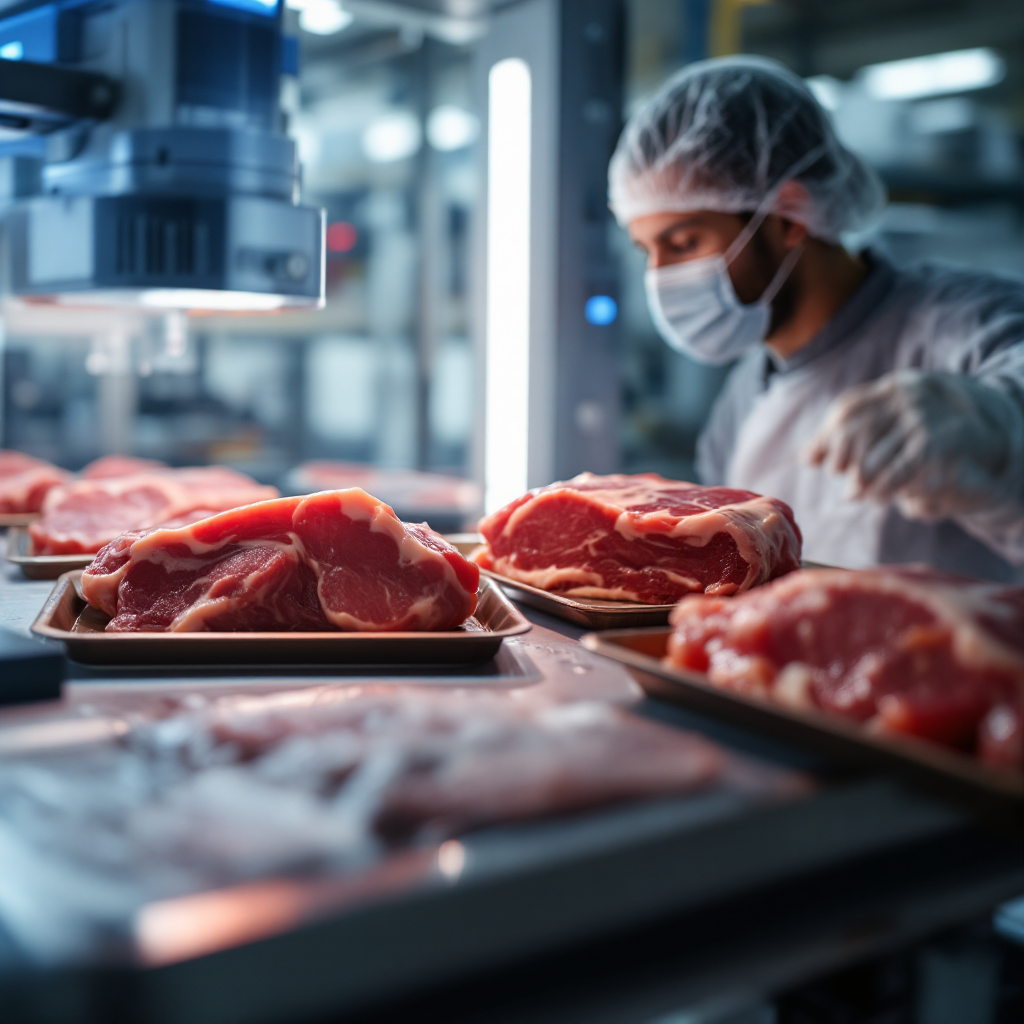
Meat quality, carcass quality and chicken carcass case studies
Comparative grading shows differences between beef and poultry. Beef carcass grading prioritises marbling and muscle depth while poultry often focuses on uniformity, carcass weight, and skin defects. A model for beef may need extra spectral or texture features, and a separate pipeline suits chicken carcass evaluation. The chicken carcass workflow often requires faster capture rates because throughput is higher on poultry lines.
Real-world deployments report throughput gains and measurable return on investment. In one study involving hundreds of samples, AI and computer vision detection reduced inspection time and increased consistency compared to manual grading. Another trial used EfficientViT for beef carcass grading and showed that a lightweight vision transformer can achieve near-expert levels of agreement while running on edge hardware Beef Carcass Grading with EfficientViT. These case studies show potential ROI through labour savings, fewer rejections, and better product segmentation.
Ongoing challenges remain. Lighting variability and carcass positioning introduce noise. Dataset bias occurs if the training set underrepresents breeds or lighting conditions. Model robustness improves with diverse data and with techniques like carcass image segmentation and augmentation. Explainability also matters: processors ask how a classification model reached a score, especially for high-value beef grading. Future work focuses on edge explainability, AI audit trails, and federated retraining that keeps data local.
Edge compute and explainable AI let graders inspect model decisions and tune rules. Visionplatform.ai supports on-prem edge deployment and transparent configuration so models remain auditable and datasets stay under customer control. Using existing camera networks means that users can scale machine vision based inspections without rip-and-replace projects. For more on process-level anomaly detection that complements grading, see how process-anomaly-detection integrates with camera feeds process-anomaly-detection in airports.
FAQ
What is AI-based carcass grading?
AI-based carcass grading uses algorithms to analyse images and sensor data to score carcass traits such as marbling, fat distribution, and muscle depth. These systems automate decisions and provide repeatable records for quality control and trading.
How accurate is a computer vision system for predicting marbling?
Accuracy varies by dataset and model, but published studies show high agreement with expert graders when models are trained on diverse, annotated carcass images. For example, an improved YOLOv8x model demonstrated measurable accuracy gains in marbling grading Research on Beef Marbling Grading Algorithm.
Can AI predict the quality of meat across different breeds?
AI can predict meat quality across breeds if the training data includes representative samples. Without diverse data, models may show dataset bias, so it is best to include many breeds, ages, and rearing conditions in the training set.
What sensors complement computer vision for meat quality assessment?
Spectral imaging and REIMS are common complements. These modalities add biochemical and spectral signatures to visual features, which improves classification and traceability Machine Learning in the Assessment of Meat Quality.
Is edge deployment necessary for carcass grading?
Edge deployment reduces latency and keeps image data local, which helps with GDPR and EU AI Act compliance. On-prem solutions also avoid vendor lock-in and let processors own their models and training data.
How much data do I need to train a prediction model?
More annotated images yield better models, but quality of annotations matters most. Start with a well-labelled set that covers expected variance, then expand with active learning to improve weak spots.
Do these systems work for chicken carcass grading?
Yes, but chicken carcass workflows differ because of higher throughput and different quality targets. Models need retraining and different capture setups for reliable chicken carcass evaluation.
How do you validate AI scores against sensory quality?
Validation involves side-by-side tests with expert panels and sensory panels that score tenderness, flavour, and aroma. Correlation between model outputs and panel scores supports deployment decisions.
Can the same camera be used for security and grading?
Yes. Using existing CCTV as an operational sensor lets sites run grading and security analytics from the same cameras. Platforms that integrate with VMS can publish structured events for operations as well as alarms forensic-search in airports.
How do I start a pilot for AI carcass grading?
Begin with a small line, gather labelled images, and choose a lightweight model for edge testing. Validate model outputs against experts, then expand the dataset and integrate the system with your VMS and MES for operational use.